

Pavé arranges small diamonds across a metal surface; channel setting holds a row between metal walls. One can read as a field of light, the other as a defined ribbon. Construction, stone size and finished edges determine the practical differences in the band you choose.
Understand what holds the stones
In a pavé design, many small metal contacts can appear between diamonds. The exact arrangement varies: shared prongs, individual beads and different rows create different patterns.
In a channel design, the rails form a visible boundary along the stones. The seat, fit and finishing of the channel are important. A continuous edge is not a guarantee that every diamond is secure.
| Consideration | Pavé | Channel setting |
|---|---|---|
| Top appearance | More individual small metal contacts | A clearer rail along the diamond line |
| Stone arrangement | Can support varied patterns and rows | Often organized as a row within a channel |
| Touch and wear | Fine contacts need sound finishing | Rail height and edges affect feel |
| Maintenance | Small settings need inspection | Channel fit and stone movement need inspection |
Decide how much metal you want to see
A pavé band can give a delicately textured surface. A channel-set band may create a more framed line. Neither impression is determined by the name alone: diamond size, rail width, gold color and the overall band width change the result.
Compare at normal viewing distance rather than judging only a magnified image. Fine workmanship should also be assessed with appropriate close examination, but the way you wear the jewel is another useful scale.
Check neighboring rings
When a diamond band sits beside an engagement ring, look at the contact points. Stones, beads or rails can meet a basket or prong rather than a smooth band surface.
Ask whether the pair was designed to be worn together and whether a gap or spacer is appropriate. A band that looks neat in isolation may behave differently in a stack.
Ask about sizing before purchase
Changing a diamond-set band's circumference can affect its settings. The distribution of diamonds around the band and the amount of plain metal available matter alongside the setting style.
Do not assume that channel setting is always resizable or that pavé is always impossible to adjust. Request an assessment of the exact design and the proposed amount of change. A full eternity construction needs a separate sizing conversation.
Choose a care routine for the complete band
Remove it for heavy pressure and impact. Arrange inspection if a diamond moves, a bead catches or the channel appears damaged. Avoid probing a stone with a tool.
Cleaning access varies, especially underneath the diamond line. Follow advice for all materials present, including any treated gems. A setting with multiple small stones should not be put into an ultrasonic cleaner merely because its main stones are diamonds.
Inspect the stone seat and the band edges
Ask the jeweler to point out the metal holding the stones. In pavé, small beads or related retaining elements can be difficult to judge from a distant photograph. In a channel, look at how the row sits between the walls and whether the outer edges feel smooth.
| Detail | Pavé question | Channel question |
|---|---|---|
| Retention | Where are the beads or prongs contacting each stone? | How do the walls retain the row? |
| Surface | Are the retaining elements smooth and intact? | Are the walls and edges even and undamaged? |
| Stack | Can adjacent metal rub the setting? | Where do the neighboring bands touch? |
| Adjustment | What happens to stone seats if the size changes? | How would an adjustment affect the channel? |
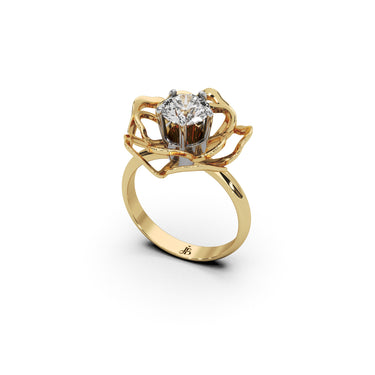
The Solitaire ring with a pavé band is one Just Brilliant example of a center stone with a finer line of surrounding light. A design photograph explains the composition; setting security still requires examination of the individual ring.
For either construction, agree on inspection and repair advice for that particular band rather than assuming the setting name establishes its service needs.

Choose the line of light you prefer, then inspect how it is held. A setting name describes an approach; the finished construction deserves its own attention.
Sources: GIA ring-setting guide; GIA side-stone setting guide.