

Gold fineness describes the share of gold in an alloy: 18K contains 75% gold, while 14K contains about 58.3%. The remaining metals influence color and behavior. Fineness is precise; a claim that one alloy is always stronger or more comfortable is much less so.
Understand what karat measures
Karat describes gold fineness, while carat describes gemstone weight. An 18K marking says something about the metal's gold content, not the diamond's size or the total quality of the jewel.
| Feature | 14K gold | 18K gold |
|---|---|---|
| Gold proportion | About 58.3% | 75% |
| Remaining alloy proportion | About 41.7% | 25% |
| Color | Depends on the alloy and surface | Depends on the alloy and surface |
| Practical durability | Requires the actual alloy and design to be assessed | Requires the actual alloy and design to be assessed |
The arithmetic does not establish the composition of the non-gold portion. Two white-gold alloys with the same karat can use different metals.
Compare real color samples
Yellow gold, rose gold and white gold are alloy families. Their visible color depends on the composition, and white gold may have rhodium plating that changes the surface appearance.
Compare finished pieces under similar lighting. A polished 14K band and a satin 18K band change both alloy and finish, so they do not isolate a color difference.
For a matching stack, assess the actual pieces together. Matching the karat number does not guarantee a perfect visible match across different alloys or finishes.
Treat wear as a construction question
You may hear that 14K is always tougher or that 18K is always too soft for daily jewelry. Those statements simplify a more specific issue. Alloy formulation, manufacturing, heat treatment, dimensions and setting construction affect behavior.
A substantial band and an extremely fine diamond-set band should not be judged solely by their shared karat. Ask about the shank, prongs, links and intended use of the particular design.
Both materials can show surface wear. A scratch does not mean the gold fineness was wrong, and a higher gold proportion does not make the jewelry immune to impact or chemicals.
Keep price comparisons meaningful
Gold content is one component of a jewel. Stone characteristics, metal weight, craftsmanship, construction and service terms also influence the complete purchase.
Comparing two price tags without matching those details does not isolate the cost of changing karat. A lighter 18K jewel and a heavier 14K jewel may not contain the amounts of fine gold you first assume.
Ask for an accurate material description
Confirm whether the item is solid throughout the stated alloy, rather than gold plated or another construction. Ask about the exact white-gold alloy if nickel sensitivity is relevant, and about any surface plating.
Read fineness as a composition, not a wear score
In a 10 g illustrative alloy sample, 18K corresponds to 7.5 g of gold and 2.5 g of other alloy constituents. At 14K, the corresponding shares are about 5.83 g and 4.17 g. This calculation explains fineness; it does not price a finished jewel or determine its hardness.
| Comparison | Hold these details constant |
|---|---|
| Color | Compare the same gold color and known alloy formulations |
| Wearing feel | Use similar band width, thickness and interior profile |
| Surface wear | Consider finish, use and the actual alloy rather than karat alone |
| Skin sensitivity | Request alloy and plating information, not just “14K” or “18K” |
| Construction | Examine joints, settings and thickness separately |
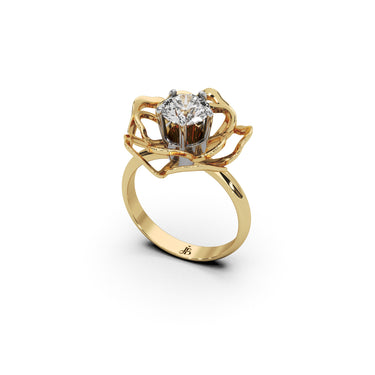
Just Brilliant's Eternal Cascade is described in 18K white gold. That is a specific material choice in a specific ring; this educational comparison does not imply that a 14K version is offered.
If two samples differ in color or feel, ask which other variables changed before attributing the whole difference to fineness.
Choose a known alloy in a well-made design. The karat number explains composition, while the finished jewel tells you how that composition has been used.
Source: Blue Nile guide to gold fineness.