

An oval diamond introduces length; a round diamond creates a more circular composition. Choosing between them becomes clearer when the outline, light pattern and setting are considered separately. For clients in Tashkent, actual Just Brilliant design references and the selected stones' measurements are more useful than expecting a shape name to predict every detail.
Use our designs to understand the outlines
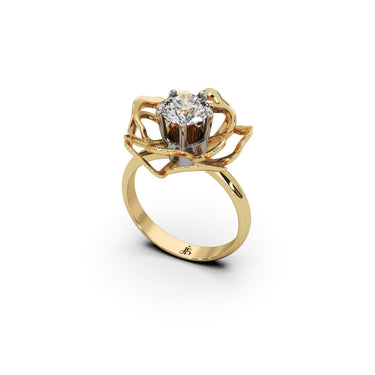
The oval configuration of the Wrapped Solitaire places an elongated stone within a flowing polished band. The Diamond Solitaire Ring shown here gives a round stone a more centered presence. Compare the outline and the way the gold supports it.
These are different settings photographed as particular creations. Their photographs are not a controlled comparison of two diamonds at an identical size or weight. Use them to choose a design direction, then ask for the actual measurements of the stones under consideration.


Calculate the outline before judging size
For an oval, divide length by width to obtain its length-to-width ratio. As a numerical example, 9.8 × 7.0 mm gives a ratio of 1.40; 9.8 × 6.5 mm gives about 1.51. The second outline is narrower at the same length. These are teaching examples, not descriptions of available stones.
A ratio describes the outline, not light performance. It does not establish depth, facet arrangement or the appearance of the center. For either shape, compare length, width and depth with carat weight and the intended setting. A larger display image is not evidence of a larger physical stone.
Observe brightness and contrast in motion
Oval brilliant diamonds can show a central bow-tie pattern. Ask to see whether the area is narrow or broad, how dark it appears and how it changes as the diamond moves. Some contrast is part of the visual pattern; one still photograph cannot explain its persistence.
A round brilliant also needs individual examination. Look for an appealing distribution of bright and dark areas under consistent lighting. A cut assessment, when supplied for the relevant report type, adds information; it does not replace looking at the stone. Avoid comparing the grading terminology of different report services as though all headings were equivalent.
Consider the future wedding band
An elongated stone and a circular one can meet a wedding band differently because the supporting settings differ. Examine the profile, the space beneath the center and any contact with the second ring. The question is whether the selected constructions work together, not whether all oval or all round rings have the same fit.
For a request from Tashkent, send the two product links through Write to an Advisor, with your preferred metal and diamond origin. Ask for the dimensions and available views needed to resolve the comparison. Choose the outline the wearer enjoys within a setting suited to how the ring will be worn.
Explore engagement rings for Tashkent
- Engagement Rings for Tashkent: Discover Just Brilliant
- Choosing an Engagement Ring from Tashkent: The Just Brilliant Guide
- White, Yellow or Rose Gold? Engagement Rings for Tashkent — Just Brilliant
Oval Diamond Engagement Rings in Tashkent: Shape, Proportion and Setting · Round Diamond Engagement Rings in Tashkent: Brilliance and Balanced Proportions
Editorial illustration inspired by Tashkent. Jewelry is shown as an artistic study.